

When the Wisdom of Crowds Becomes Extortion

May 7, 2026
by LIOR ZOREF
 @lior
@lior
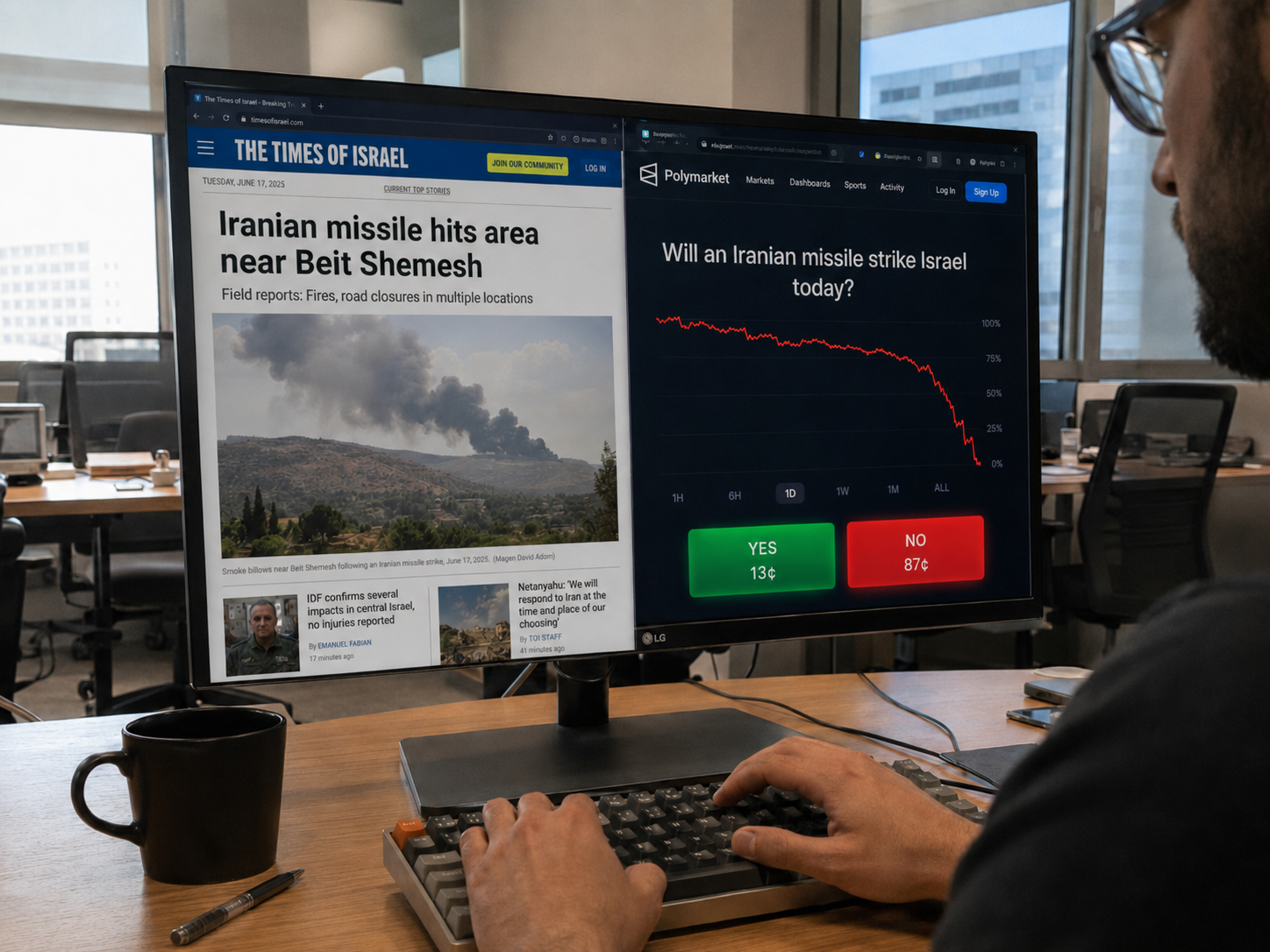
What happens when the wisdom of crowds becomes extortion?
Journalist Emanuel Fabian discovered this the hard way after reporting on an Iranian missile strike near Beit Shemesh.
Polymarket is a platform built on the wisdom of crowds for forecasting world events. In recent months, it has been filled with bets about the war with Iran. On March 10, 2026, for example, people put $14 million behind the question: “Will Iran hit Israel today?” According to the rules, an interception or falling debris does not count as a hit.
That day, an Iranian missile landed in an open area. There were no casualties. Fabian’s report meant the answer was “yes” – a hit – which would cause bettors who chose “no” to lose millions of dollars.
Polymarket users demanded that he change the wording to “interception debris” in order to reverse the outcome.
At first, the messages were polite requests asking him to “correct” the article. Then Fabian realized they were not ordinary readers, but Polymarket users. At a certain point, the pressure turned into a threat.
One bettor wrote that if Fabian caused him to lose $900,000, he would spend no less than that to “finish him.” Later, he wrote that he knew where Fabian lived and who his family members were. In a single night, he sent more than 100 messages. Eventually, an English-language threat arrived:
“You have 90 minutes left to update the lie.”
Fabian chose not to give in. He contacted the police and published the story in The Times of Israel.
Prediction markets like Polymarket are supposed to represent the wisdom of crowds at its best: thousands of participants, each pricing the probability of an event, together creating a forecast. The idea is beautiful. But as these markets grow, their darker sides become visible.
In February 2026, an indictment was filed against a reserve major in the Israeli Air Force for using classified information to bet on the timing of Israel’s June 2025 strike in Iran.
In Fabian’s case, the wisdom of crowds led to extortion and threats against a journalist’s life in an attempt to influence the result.
The interesting question is not only how to protect journalists. It is deeper than that: when a large financial incentive is added, are we still talking about the wisdom of crowds, or does it become a gambling arena that can lead to extortion and threats?
I still believe in the wisdom of crowds. But Fabian’s story is a reminder that every technology needs boundaries.